
Compressed air naturally carries moisture. A refrigerated air dryer reduces moisture in the compressed-air stream before it reaches downstream equipment and processes.
Pneumatix PMD refrigerated air dryers can be selected as part of a new compressed-air system or matched to a Base Mount installation based on the required flow and operating conditions. A dryer is not selected only from compressor horsepower: its duty depends on airflow, pressure, temperature and the conditions at the installation.
Why moisture appears in compressed-air systems
Atmospheric air contains water vapour. Compression increases the concentration of that moisture, and cooling after compression causes part of it to condense. Without suitable separation, draining and drying, water can collect in receivers and pipework or reach equipment at the point of use.
What a refrigerated dryer does
A refrigerated dryer cools compressed air so moisture can condense and be separated under controlled conditions. The air is then returned toward the distribution system with a lower moisture load than untreated compressed air.
Size the dryer for real operating conditions
- maximum compressor airflow that can reach the dryer
- normal and maximum operating pressure
- maximum ambient temperature around the dryer
- compressed-air inlet temperature
- ventilation around the dryer condenser
- allowable pressure drop
- future compressor or demand growth
- required downstream air quality
Published dryer capacities are normally based on defined reference conditions. Higher ambient or inlet temperatures can reduce effective capacity, so correction factors may need to be applied. Match the dryer to its rated capacity at your site’s conditions rather than to the number in its model name. Pneumatix can confirm the right PMD unit for a given ambient and inlet temperature.
The Pneumatix PMD range
Two refrigerated dryers are offered. They share a dew point range, refrigerant and cabinet footprint, and differ in rated capacity, input power and weight. Both are rated to 16 bar working pressure and carry a one-year warranty.
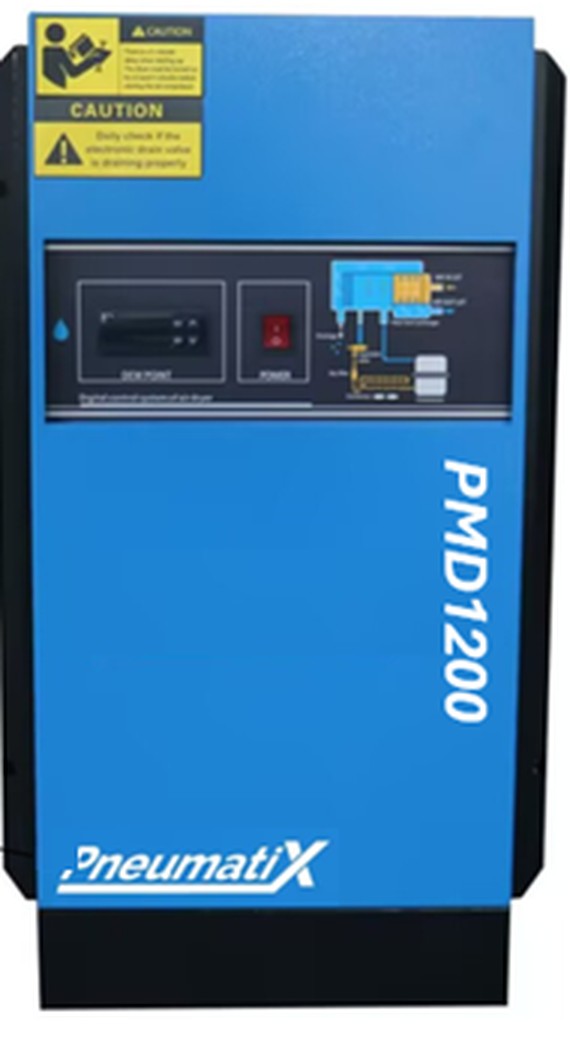
| Model | Rated capacity | Dew point | Refrigerant | Compressed-air inlet | Input power (230 V / 50 Hz) | Maximum working pressure | Dimensions (L × W × H) | Weight |
|---|---|---|---|---|---|---|---|---|
| PMD1200 | 1,200 L/min | 2 to 10 °C | R134a | 3/4 inch | 350 W | 16 bar / 235 PSI | 520 × 410 × 725 mm | 30 kg |
| PMD2400 | 2,400 L/min | 2 to 10 °C | R134a | 3/4 inch | 530 W | 16 bar / 235 PSI | 520 × 410 × 725 mm | 39 kg |
PMD1200
- Rated capacity
- 1,200 L/min
- Dew point
- 2 to 10 °C
- Refrigerant
- R134a
- Compressed-air inlet
- 3/4 inch
- Input power (230 V / 50 Hz)
- 350 W
- Maximum working pressure
- 16 bar / 235 PSI
- Dimensions (L × W × H)
- 520 × 410 × 725 mm
- Weight
- 30 kg
PMD2400
- Rated capacity
- 2,400 L/min
- Dew point
- 2 to 10 °C
- Refrigerant
- R134a
- Compressed-air inlet
- 3/4 inch
- Input power (230 V / 50 Hz)
- 530 W
- Maximum working pressure
- 16 bar / 235 PSI
- Dimensions (L × W × H)
- 520 × 410 × 725 mm
- Weight
- 39 kg
Rated capacity is the reference figure for the dryer. Actual duty depends on inlet temperature, ambient temperature and operating pressure at the installation, so confirm the selection against site conditions.
Inline filtration around the dryer
PMF inline filters are used in pairs around the dryer: a pre-filter ahead of it to remove bulk contamination, and a post-filter after it for finer coalescing duty. Each filter is a housing with a replaceable cartridge.
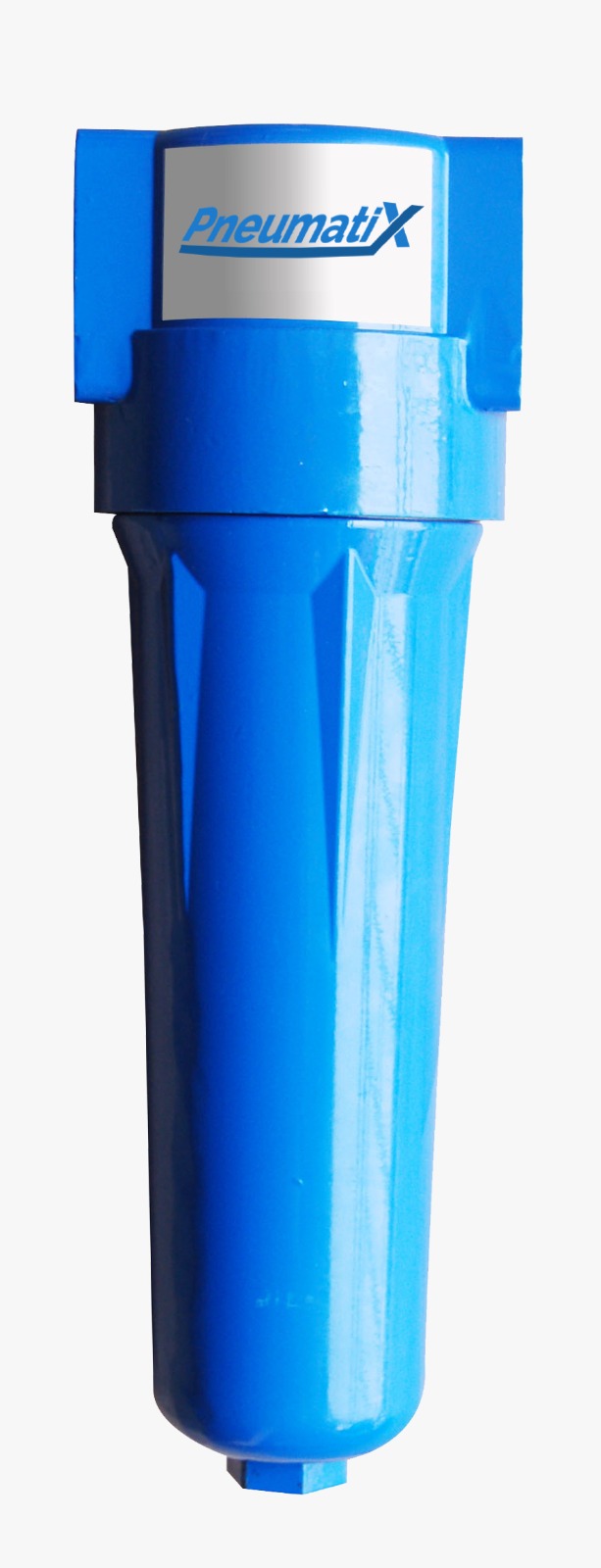
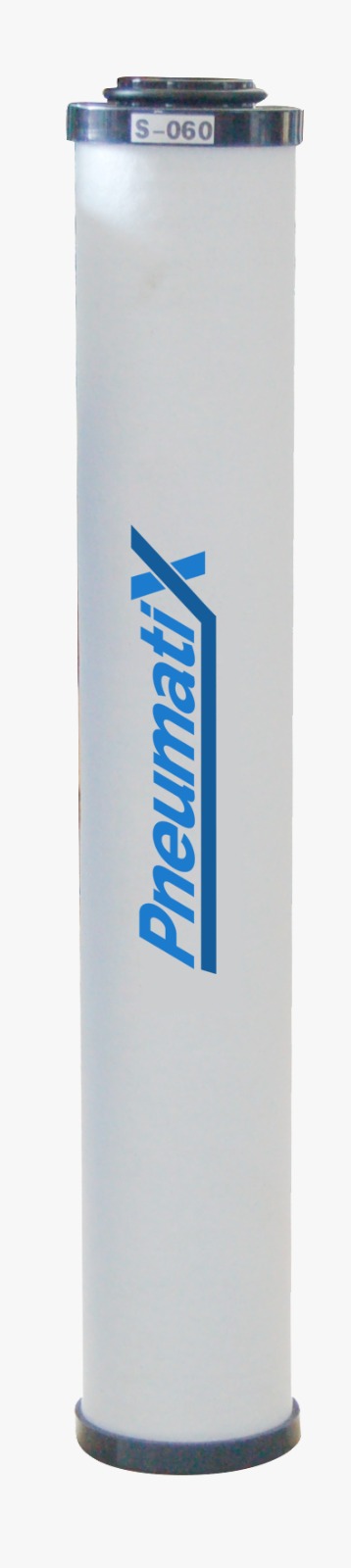
| Model | Position | Filtration grade | Rated flow | Inlet and outlet | Maximum working pressure | Dimensions | Weight |
|---|---|---|---|---|---|---|---|
| PM10PREINLINE | Pre-filter | 1.0 micron | 1,200 L/min | 3/4 inch | 16 bar / 235 PSI | H285 × 90 mm dia. | 1.2 kg |
| PM10POSTINLINE | Post-filter | 0.01 micron | 1,200 L/min | 3/4 inch | 16 bar / 235 PSI | H285 × 90 mm dia. | 1.2 kg |
| PM20PREINLINE | Pre-filter | 1.0 micron | 2,400 L/min | 3/4 inch | 16 bar / 235 PSI | H345 × 110 mm dia. | 1.85 kg |
| PM20POSTINLINE | Post-filter | 0.01 micron | 2,400 L/min | 3/4 inch | 16 bar / 235 PSI | H345 × 110 mm dia. | 1.85 kg |
PM10PREINLINE
- Position
- Pre-filter
- Filtration grade
- 1.0 micron
- Rated flow
- 1,200 L/min
- Inlet and outlet
- 3/4 inch
- Maximum working pressure
- 16 bar / 235 PSI
- Dimensions
- H285 × 90 mm dia.
- Weight
- 1.2 kg
PM10POSTINLINE
- Position
- Post-filter
- Filtration grade
- 0.01 micron
- Rated flow
- 1,200 L/min
- Inlet and outlet
- 3/4 inch
- Maximum working pressure
- 16 bar / 235 PSI
- Dimensions
- H285 × 90 mm dia.
- Weight
- 1.2 kg
PM20PREINLINE
- Position
- Pre-filter
- Filtration grade
- 1.0 micron
- Rated flow
- 2,400 L/min
- Inlet and outlet
- 3/4 inch
- Maximum working pressure
- 16 bar / 235 PSI
- Dimensions
- H345 × 110 mm dia.
- Weight
- 1.85 kg
PM20POSTINLINE
- Position
- Post-filter
- Filtration grade
- 0.01 micron
- Rated flow
- 2,400 L/min
- Inlet and outlet
- 3/4 inch
- Maximum working pressure
- 16 bar / 235 PSI
- Dimensions
- H345 × 110 mm dia.
- Weight
- 1.85 kg
Integrated and separate dryer arrangements
Total Air Stations
PM10 and PM20 Total Air Stations include a tank-mounted refrigerated dryer as part of the coordinated package. This can be practical where the integrated dryer capacity and air-quality arrangement suit the application.
Base Mounts
Base Mounts require a separate dryer. This creates more flexibility to select the dryer around the complete system, position it for ventilation and service, or provide treatment for an existing receiver and distribution network.
Installation considerations
- provide the ventilation and clearance required by the current manual
- avoid recirculating hot condenser air
- install isolation and bypass arrangements where specified
- provide reliable condensate drainage
- keep the dryer accessible for cleaning and service
- confirm electrical supply requirements
- avoid undersized connecting pipework and restrictive fittings
Maintenance and ongoing performance
Dryer performance depends on clean heat-exchange surfaces, working drains, unobstructed airflow and correct operating conditions. Maintenance should follow the current model documentation and be carried out by appropriately qualified personnel.
A dryer fault or blocked drain can allow moisture to pass downstream even when the compressor itself is operating normally. That is why treatment equipment should be included in routine system inspections.
Frequently asked questions
Does a receiver remove the need for a dryer?
No. A receiver can help collect some condensate and provide storage, but it does not provide the same controlled moisture reduction as a correctly selected dryer.
Can a dryer be too small even if it matches the compressor horsepower?
Yes. Airflow, pressure, ambient temperature and inlet temperature can change the required dryer capacity.
Are refrigerated dryers suitable for every process?
Not necessarily. Some processes require a different dew point or more specific treatment. The process requirement should be confirmed before selection.
Do Total Air Stations include a dryer?
The PM10 and PM20 Total Air Stations include an integrated refrigerated dryer. Base Mounts do not.
Parts and ongoing support
Refrigerated drying is one stage of the treatment train. Filters, cartridges and dryer servicing are available through approved service providers and the dealer network.
Confirm dryer duty before the system is ordered
Provide the compressor model, expected airflow, operating pressure, ambient conditions and application. Pneumatix or your dealer can then review the appropriate dryer range and treatment arrangement.