
A compressor should be selected and installed as part of the complete site system. Electrical capacity, ventilation, service access, air storage, treatment, condensate management and pipework can all affect reliability and performance.
Confirm the actual electrical capacity
Do not rely only on the rating of the main switch inside the tenancy. Upstream protection in a meter position, pillar or service arrangement may be smaller, and existing site loads can reduce the capacity available to new machinery.
The review should consider compressor running current, starting behaviour, other simultaneous loads, cable route, voltage drop, isolation and protection. Final electrical work must be completed by appropriately licensed persons for the installation location.
For the PM10 and PM20 Total Air Stations, the Pneumatix best practice electrical installation guides set out the preferred supply, local isolation, dryer GPO, circuit protection, cable and gland arrangement, together with a pre-energisation checklist for the installing electrician. Download the current revision from the Pneumatix document library.
Choose a suitable location
- stable, suitable support surface
- clear service access
- clean cooling-air path
- no immediate recirculation of hot discharge air
- protection from unsuitable environmental exposure
- reasonable pipe and electrical routes
- noise and neighbouring work areas considered
- safe access to isolation and drains
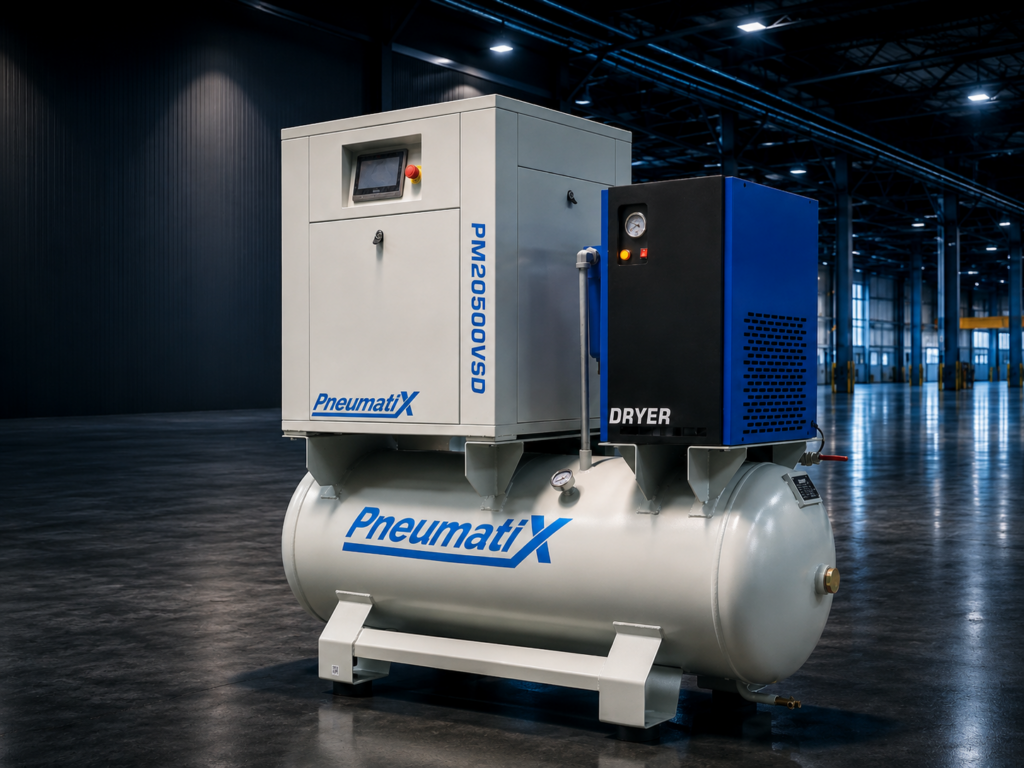
Ventilation and heat rejection
The compressor and refrigerated dryer reject heat into the surrounding area. The room or enclosure must provide the airflow and clearances required by the current product manual. A compact room is not suitable if hot air is trapped and drawn back into the cooling intake.
Receiver, dryer and filtration
PM10 and PM20 Total Air Stations include their approved receiver-mounted package. Base Mounts require the receiver and air-treatment system to be selected separately. Confirm storage, dryer duty, filtration and drain requirements before the layout is finalised.
Pipework and pressure drop
Pipe diameter, length, fittings, filters and regulators all affect the pressure available downstream. Design the distribution system for peak flow and future branches rather than extending undersized pipework after equipment is installed.
Provide isolation points and drainage where practical. Avoid using flexible hose as a substitute for a properly planned main distribution system.
Condensate management
Receivers, dryers and filters can collect condensate. Provide reliable drains and a suitable disposal pathway. Do not allow uncontrolled discharge to create a slip, corrosion or environmental problem.
Delivery and access planning
Check product and shipping dimensions, weight, doorway access, lifting method and final positioning before delivery. Base Mount dimensions must come from the approved product data and must not be copied from Total Air Station packages.
Commissioning
The current commissioning or communications sheet must be completed, together with any additional requirements in the approved warranty and commissioning documents. Record model, serial number, installation details and initial operating information.
Before energisation checklist
- correct model and supply confirmed
- electrical installation complete and tested
- transport restraints or packaging removed as required
- oil and service checks completed to the manual
- ventilation and clearances confirmed
- receiver and treatment system connected correctly
- drains installed
- pipework clean and pressure tested by appropriate parties
- commissioning sheet available
- service contacts recorded
Frequently asked questions
Can the compressor be placed in a small cupboard?
Only if the current manual clearances and ventilation requirements can be met. Heat recirculation must be avoided.
Is a 415 V supply enough information?
No. Actual available capacity, protection, cable route and existing load still need to be reviewed.
Can a Base Mount use any receiver?
The receiver must be suitable for the pressure, capacity, condition, registration and installation. Appropriately qualified parties should confirm it.
Who should commission the compressor?
Follow the current Pneumatix documentation and approved service pathway for the model and installation.
Resolve the site requirements before the compressor arrives
Provide the proposed location, electrical information, receiver and treatment arrangement. Pneumatix, your dealer and the relevant installers can then address the installation requirements before delivery.