
A workshop compressor should be selected from what the workshop actually runs, not from a generic number of bays or technicians. Two workshops with the same floor area can have very different compressed-air demand.
Create an equipment list
Record every tool and machine that uses compressed air, the manufacturer's airflow figure, required pressure and normal operating pattern. Include equipment planned in the near future where the project is real and defined.
Identify simultaneous users
The useful peak is the equipment that can realistically operate together. Do not add every tool at full duty unless that reflects the actual process. Equally, do not ignore common overlaps simply because each tool is intermittent.
Estimate duty cycle
A tool may have a high rated airflow but operate only for short periods. Another machine may consume less air but run for much longer. Duty cycle helps describe that difference.
Confirm pressure at the equipment
The compressor-room setting must allow for pressure loss through the dryer, filters, pipework, regulators and fittings. Confirm the equipment requirement and avoid using excessive pressure to hide distribution problems.
Choose receiver storage
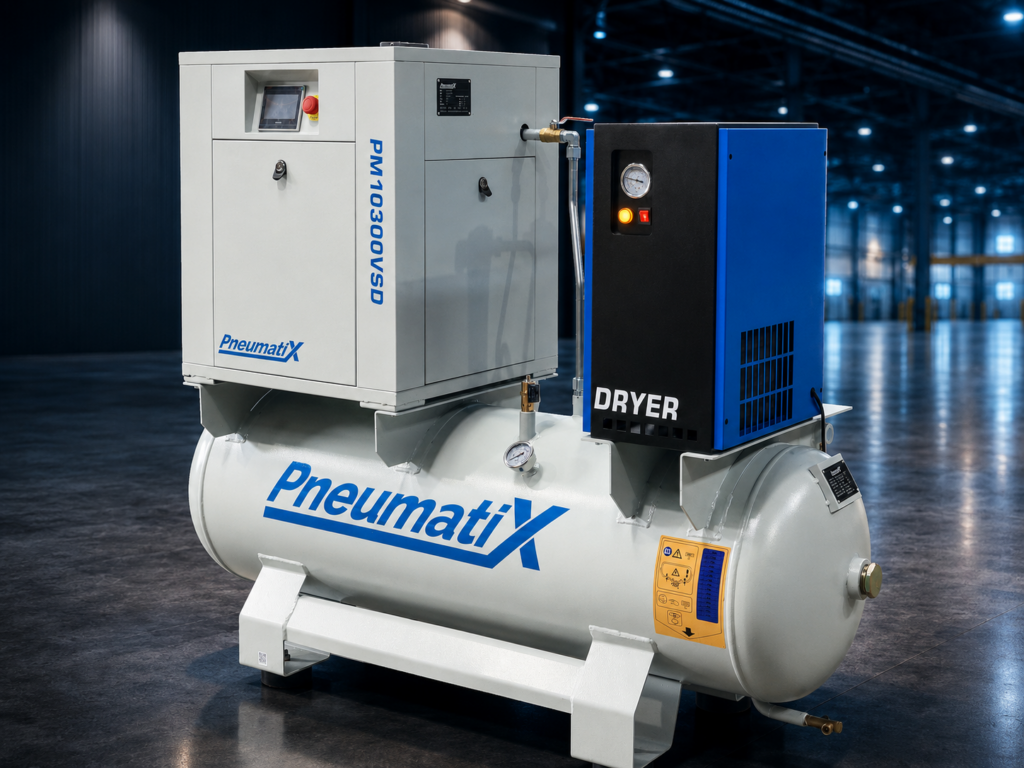
Storage can help manage short peaks and reduce pressure movement. Total Air Stations include defined receiver sizes, while Base Mounts allow storage to be selected separately.
Decide between Total Air Station and Base Mount
Choose a Total Air Station where an integrated receiver-mounted package suits the space and treatment requirement. Choose a Base Mount where storage and treatment need to be independently designed or already exist.
Check air quality
General workshop tools, CNC machines and spray applications may require different treatment. Review the equipment and process rather than applying one generic filter claim to the whole workshop.
Confirm electrical capacity
Three-phase availability does not prove enough capacity. Review existing site load, upstream protection, cable route, running current and starting behaviour.
Plan service access and ventilation
Leave the clearances required by the current manual and prevent hot discharge air from returning directly to the intake. Filters, drains, dryer and service panels must remain accessible.
Allow for growth without excessive oversizing
Include known expansion and a realistic allowance for leaks or uncertainty. Avoid buying substantially more compressor than the site can use efficiently simply to cover undefined future plans.
Frequently asked questions
How many horsepower does my workshop need?
Horsepower alone is not enough. Use verified FAD, pressure, simultaneous demand, storage and treatment requirements.
Is PM10 suitable for a small workshop?
It may be, where the measured peak demand fits within 1,000 L/min at 8 bar and the system is designed appropriately.
When should PM20 be considered?
Where simultaneous demand, higher-flow equipment or defined growth exceeds the practical PM10 range.
Do I need a separate dryer?
PM10 and PM20 Total Air Stations include a dryer. Base Mounts require a separate treatment system.
Build the selection from the equipment list
Send the tool and machine information, expected simultaneous use and existing infrastructure. Pneumatix or your dealer can then review the most suitable configuration.